Google AdSense Approval Rejection: What is the Reason and How Should You Respond?
We analyze the reasons for Google AdSense approval rejection for blog monetization and provide guidance on effective reapplication methods. We diagnose content issues and policy violations, which are the main causes of AdSense rejection, and systematically present AdSense approval response methods through content quality improvement, reflection of modification history, and adjustment of reapplication timing. Use approval rejection as an opportunity to enhance the completeness of your blog.
AdSense Approval Rejection Response Strategy: From Content Audit to Reapplication
When you receive a rejection notice after applying for Google AdSense, many bloggers feel frustrated because Google does not disclose the specific AdSense rejection reasons. However, broadly speaking, there are two core causes: content issues and policy violations. Upon rejection, it is important to audit all content and use a strategy of reapplying with a few well-written pieces of content. Additionally, rather than reapplying immediately after modifying content, it is better to apply after allowing sufficient time.
It would be ideal to get approved immediately after applying for Google AdSense after creating content, but rejection is common. How do you deal with an AdSense approval rejection? Can you tell why it was rejected? Google does not clearly state the reasons, which makes it quite difficult. If your Google AdSense approval is rejected, try the following.
Analysis of Major Causes for Google AdSense Approval Rejection
The primary factors for Google AdSense rejection are content issues and policy violation reasons. Sometimes, both can be the cause of rejection.
Identification of AdSense Approval Rejection Factors and Countermeasures
- Policy Violation Reasons: Check for commercial elements (excessive affiliate marketing, clickbait) and third-party content (copyright infringement, plagiarism, unauthorized copying) and immediately edit or delete them.
- Content Quality Issues: Check if the content is text-only; you must include at least minimal visual elements (images, tables). Inspect the HTML code for unnecessary code between words and remove it.
- Reflecting Modification History: You should audit all content, not just the content you suspect has problems. After editing, ensure that the modification date is reflected in the metadata. Google checks the modification date of a page to determine if the operator has made efforts to improve.
- Technical Optimization: Check for issues in Search Engine Optimization (SEO). Perform a content optimization check at the Google PageSpeed Insights site to improve loading speed and user experience scores.
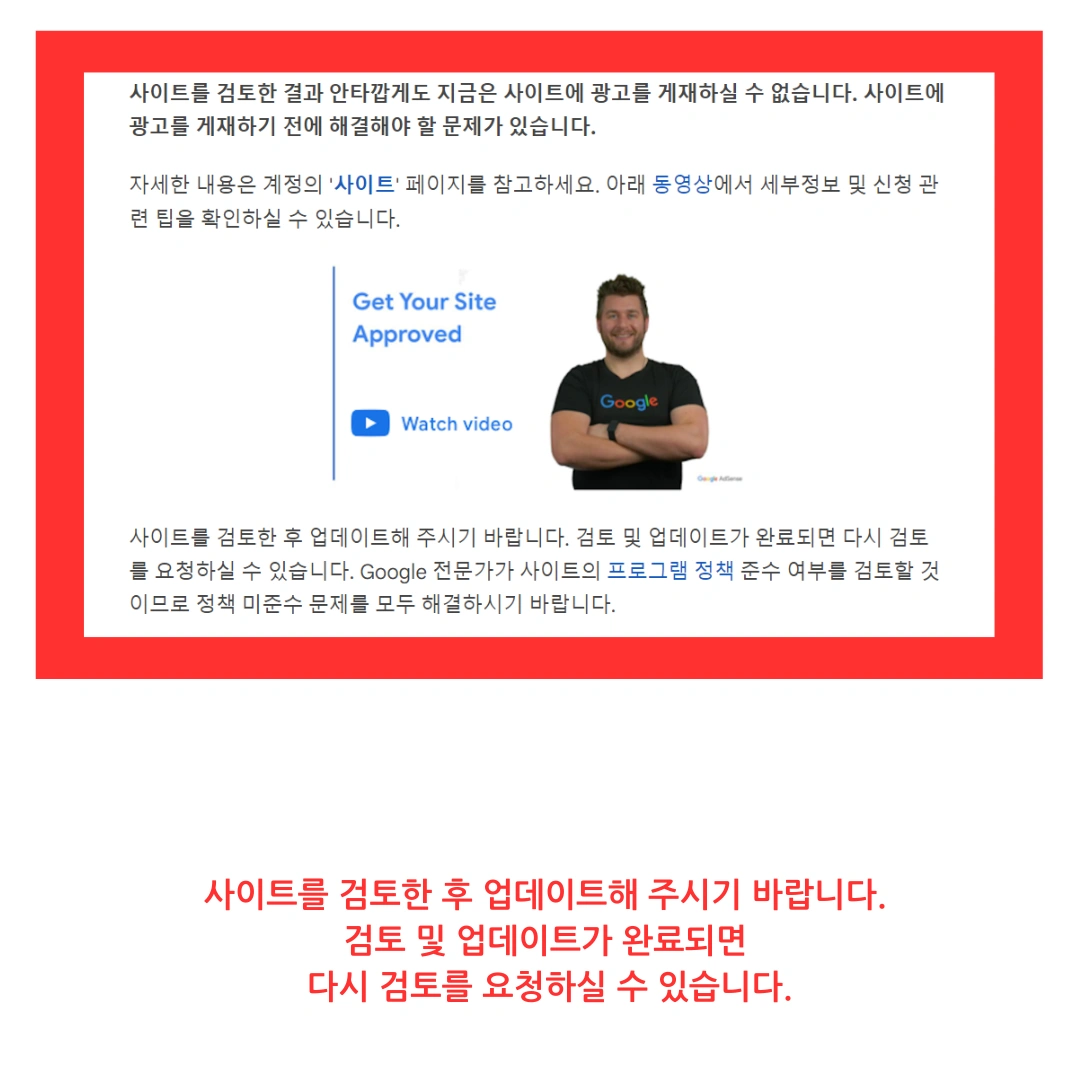
How to Reapply After AdSense Approval Rejection and Tips
1. Re-audit All Content
It is recommended to audit all content rather than just the posts you suspect are problematic. Therefore, you should avoid creating too much content before your first AdSense application. This is because the volume of content to audit and modify increases. If you only modify a few suspicious posts and reapply, the probability of being rejected again is high.
When you edit a page, the modification history is recorded in the metadata, making it easy for Google to see if the operator made an effort to edit the text. In other words, Google can verify the editing work just by checking the page change date (last-modified). This serves as an important indicator showing the operator's sincerity.
2. Do Not Reapply Immediately After Rejection
If you have a small amount of content, it is best not to reapply immediately after editing. Even if you apply right away, approval is rarely granted instantly. However, if you have spent significant time modifying a large volume of content, approval is sometimes granted immediately. This is because Google highly values the effort and sincerity of the operator, leading to instant approval.
3. Reapply with a Reduced Quantity of Content
Even if you have modified many posts, it is better not to submit all of them. To reduce the possibility of potential issues, it is actually better to select and submit only the best-written, high-quality content. Try selecting about 10 to 20 pieces of killer content that utilize long-tail keywords effectively and provide in-depth information to users.
Summary of Tips for Google AdSense Approval
| Item | Content |
| Content Quality | Provide original and beneficial information (Differentiate from other content) |
| Visual Composition | Utilize visual elements such as images, tables, and quotes; avoid text-only pages |
| Policy Compliance | Strictly follow AdSense policies, avoiding copyright issues and sensitive keywords |
| Modification History | Update content significantly enough to be reflected in metadata (trigger change in modification date) |
| Number of Posts | More is not always better; submit only 10-20 core posts |
Rejection is Not the End, but a New Beginning (Increasing Blog Completeness)
Google AdSense review standards are stricter than expected. However, there is no need to be discouraged by a single rejection. Rather, rejection is an opportunity to check content quality and increase the completeness of your blog. Google highly values the operator's sincerity and will to improve.
If you continue to create information that is truly helpful to users and valuable text, rather than content just for show, AdSense approval will arrive before long. Set a goal to complete blog SEO optimization by focusing on improving site structure and user experience during the reapplication period.
Q1. How long should I wait to reapply for AdSense?
A1. Google does not officially set limits on the timing of reapplication. However, if you reapply immediately without sufficient modification and improvement regarding the rejection reason, the probability of rejection is high. It is most effective to wait at least 1 to 2 weeks, modify all problematic content, and verify that the modification date (last-modified) is reflected in the metadata before reapplying.
Q2. Does Google explicitly state 'Insufficient Content' as a reason?
A2. In most cases, Google does not provide a specific reason and uses comprehensive phrases such as 'Low-value content' or 'Policy violation'. In the past, they might have judged small quantities of content as 'Insufficient content', but currently, they emphasize the quality and originality of content rather than simple quantity. In other words, even with 100 posts, you may be rejected if they lack originality, whereas you can be approved with just 10 high-quality posts.
Q3. Is it okay to write posts by referring to other blogs?
A3. Simply copying or paraphrasing content from other blogs is a policy violation. Google evaluates 'Original Content' as the most important factor. Even if you refer to external information, you must add value and differentiation by including your own experience, insights, and new information or depth to get approved. This is also essential for targeting long-tail keywords.