Optimizing SEO with Internal and External Link Setup Methods
We take a detailed look at how to set up internal links and external links, which are essential elements for SEO optimization of a Tistory blog. We provide guidance on the benefits of link settings, practical ways to use the Tistory editor and plugins, and precautions for search engine exposure.
Effective Internal and External Link Setup Methods for Search Engine Optimization (SEO)
By effectively utilizing internal links and external links while writing blog posts, you can increase readers' access to information and improve visibility on search engines. In particular, Tistory blogs are advantageous for SEO optimization because links can be set up easily using only plugins or the basic functions of the editor.
Utilizing internal and external links on a blog allows you to provide additional materials to blog posts and improve the flow of information. Internal links help create natural connections between pages to increase information accessibility, while external links strengthen credibility and are beneficial for SEO optimization and article structuring.
Settings can be easily configured through Tistory plugins and the buttons at the top of the editor. The key point is to avoid using irrelevant links and to link only to information related to the post. In this article, we provide detailed guidance on the concepts and advantages of internal and external links, actual setup methods on Tistory blogs, and precautions to take when setting them up.
Understanding the Concept and SEO Importance of Internal and External Links
It is important to clearly understand the concepts and differences between internal links and external links, which are the core of a blog SEO strategy. These two types of links directly affect the quality of the post, the reader's experience, and the search engine's crawling path.
Internal Links vs. External Links: Concepts and Differences
| Classification | Description | Example |
| Internal Link | Connects to other posts or pages within the same blog | Viewing previous posts or connecting to related articles, etc. |
| External Link | Connects to other websites or external materials | Reliable sources such as Wikipedia, news articles, papers, YouTube, etc. |
Why Internal and External Links are Important for SEO
When writing a post, adding internal and external links can provide more materials to the user. Connecting information related to the content through internal and external links allows you to guide the flow of information naturally. By setting up external links that can be referenced for the post's information, you can deliver information concisely.
Structuring a post involves making it easy for readers to access and search for information related to the content. Among Search Engine Optimization structuring tasks, internal and external links allow for easy and simple structuring, enabling information to be verified at a glance.
Advantages and Utilization Strategies of Internal and External Link Setup
Advantages of Internal and External Links
Utilizing internal and external links in posts on Tistory blogs and sites offers various advantages. These benefits ultimately improve the blog's search engine ranking and user experience (UX).
1. SEO Optimization: Links play an important role in Search Engine Optimization. They connect information between pages and make the overall structure of the post easy to grasp, simplifying the search engine's indexing process.
2. Information Credibility: Links to related information can improve a user's trust in that information, and increased user trust serves to raise the quality of the post. In particular, links to authoritative external sites enhance the professionalism of the article.
3. Diversity of Information: You can provide a wider variety of information while preventing the overall content from becoming too long or complex by describing various details directly in the post.
4. Article Structuring: Through internal and external links, a post becomes simpler and overall structuring can proceed. This allows for the formation of topic clusters, increasing the organic connectivity of the entire blog.
Practical Link Setup Methods and Precautions for Tistory Blogs
Setting up internal and external links in the Tistory environment is very simple. We provide guidance on using basic editor functions, plugins, and anchor link setup methods using HTML code.
How to Set Up Internal and External Links
Methods for setting up anchor links that move to a specific location within a post and general external links are as follows.
1. Using Tistory Plugins
You can insert the address to be linked externally into the editor. On Tistory blogs, there are various plugins that make it easy to decorate posts. If you install plugins this way, you can easily set up posts written within the blog in the form of links.
✔ Example: (Example plugins: Related post list, automatic insertion of previous/next post links, etc.)
2. How to Set Up Links in a Post (Using the Editor)
You can connect external links by setting them up within the post you are writing. For Tistory, just use the link button at the top of the editor. To use it, select the text you want to set a link for and configure the link address.
✔ Example
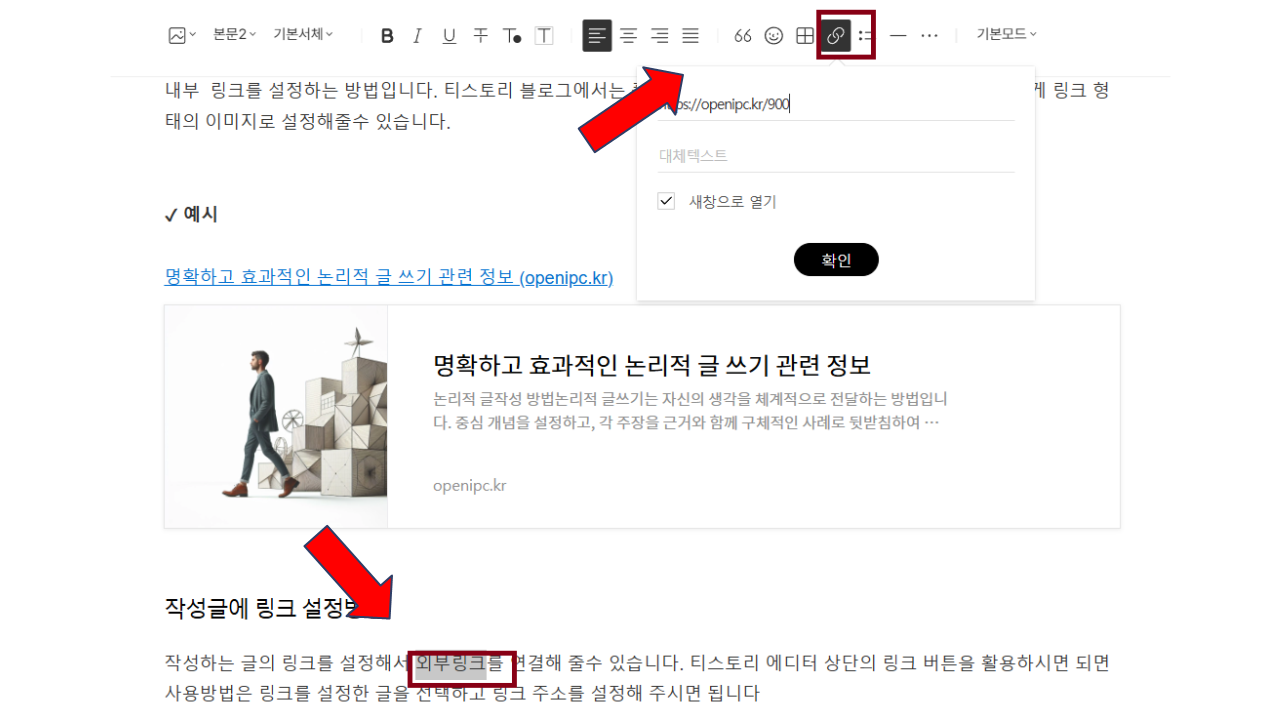
3. How to Set Up Internal Links (Using Anchor Tags)
You can link posts to each other internally by writing code. These are called in-page anchor links, and they act as a table of contents for long posts, increasing reader convenience.
✔ Example
a href="#InternalLinkSetup"Move to Internal Link Setup/a
h2 id="InternalLinkSetup"Internal Link Setup/h2
4. Precautions When Setting Up Links (Credibility and Relevance)
When setting up links, providing irrelevant information or linking to advertisements or completely different sites will decrease trust in the content and cause confusion in the overall structure. Therefore, the correct usage is to link to information related to the post. Additionally, when using external links, it is good to clearly convey intent to search engines by appropriately using rel="nofollow" or rel="sponsored" attributes.
Setting up internal and external links is essential to simultaneously achieve successful search engine exposure and a good user experience. On platforms like Tistory blog that consider user convenience, you should actively utilize this feature, along with related plugins and functions.
Q: Which is more important for SEO, internal links or external links?
A: Both links are important, but they serve different roles. Internal links increase the authority of the entire blog through organic connections (topic clusters) between pages within the blog, while external links increase the credibility of the post by citing authoritative external materials. It is best to use both in balance.
Q: Is using 'Open in a new window' for external links good for SEO?
A: Yes, it is generally recommended to use "Open in a new window" (target="_blank"). This is because even if the reader moves to an external site, the original blog page remains open, which positively affects SEO by lowering the bounce rate and increasing dwell time.
Q: Isn't it harmful to SEO to have too many internal links?
A: Having too many links on one page can confuse both users and search engines. Links should be placed appropriately only on keywords that are most natural and highly relevant in context. Generally, search engines recommend fewer than 100 links per page, and it is important to focus on quality.