Will Simply Communicating with Neighbors Increase Visitors? Core Analysis of SEO Strategy for Sustainable Blog Growth
Search traffic is more advantageous than social activity for securing consistent visitors. This article presents a method for stable blog growth through keyword research and SEO optimization.
The first concern for anyone starting a blog is the number of blog visitors and the blog growth rate. Many beginner bloggers often start by assuming that the way to increase blog visitors is simply by focusing on subscriptions, comments, and active communication with neighbors (fellow bloggers). While communication through subscribers and comments does positively affect initial traffic growth, how much does it truly help with long-term blog growth and securing sustainable traffic? Communication with neighbors can temporarily boost traffic, but relying on social activity rather than search engines weakens the long-term viability of the blog.
Limitations of Communication-Based Blogs and Sustainable Blog Operation Strategy: Why Search Engine Optimization (SEO) is Essential
In contrast, the most critical core of blog operation is focusing on the quality of the content. By consistently producing high-quality content and systematically applying a Search Engine Optimization (SEO) strategy, you can achieve natural and stable search inflow over time. This can be a much more powerful means of securing visitors than simply relying on social activity. Search engine-based traffic is the key to creating a sustainable blog.
Comparative Analysis of Content-Centered Blogs and Social Blogs
This article compares the growth patterns of two types of blogssubscription/comment-focused communication blogs and content-intensive SEO blogsfor beginners. We analyze how each operational strategy affects traffic and visitor counts, and the differences they create in long-term traffic inflow and blog activation. The goal is to help blog operators establish a rational blog operation method based on real data. Ultimately, accumulating content as a blog asset is the key to long-term growth.
If you want to increase your blog visitors and achieve a stable growth curve, let's examine the true effects and limitations of these two strategies together.
Operation Focused on Subscriptions and Comments: Achieving 1,000 Visitors in 3 Months, Followed by Stagnation
One blog, which focused on social-based communication such as adding neighbors, subscriptions, and commenting, successfully reached 1,000 daily visitors in just 3 months. Inflow through mutual comments and feedback among neighbors led to rapid spread, and the short-term growth was very successful. However, social traffic immediately drops when communication ceases, which can act as a low-quality signal to search engines.

However, over time, the blogger failed to maintain communication and neglected content quality management. Ultimately, after one year, the daily visitor count plummeted to less than 20, posing a crisis in terms of blog operation sustainability. This is a typical example of falling into the short-term traffic trap.
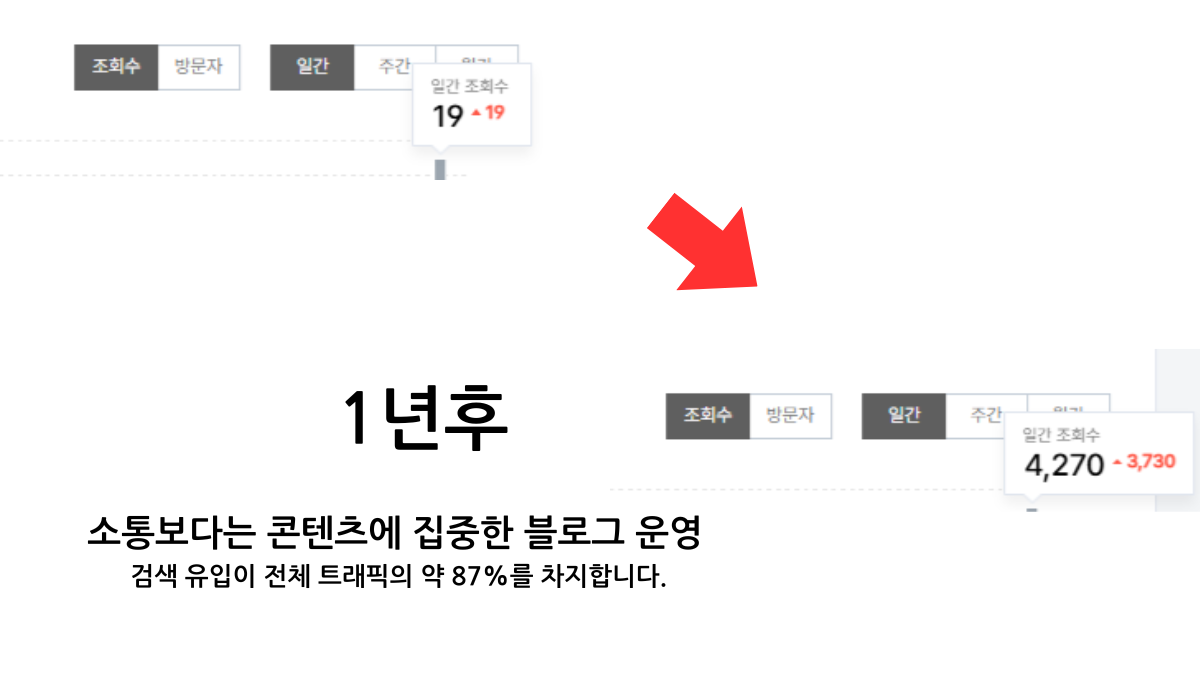
Textbook Growth of a Blog Focused on Content and Optimization: Securing Search-Based Traffic
Conversely, another blogger focused not on spending time on comments or subscription communication, but on keyword research, search algorithm optimization, and writing high-information-density content. Initially, there were less than 20 daily visitors, but through consistent SEO strategy and content publishing, the blog secured 4,000 daily traffic after one year. While this method is slow at first, accumulated search exposure leads to explosive growth over time.
87% of the total visitors to this blog came from search inflow, resulting in a stable search-based blog unaffected by seasonal changes or social activity. Especially, blogs with high search traffic like this are much more advantageous for business connections such as AdSense revenue or affiliate marketing. High dwell time and low bounce rate create a virtuous cycle that enhances blog quality.
The Vices and Virtues of Subscription Communication in Practice: Why is Communication Labor Dangerous?
In the early days of my blog operation, I closely observed one blog that repeatedly subscribed and unsubscribed every week. At that time, that blog had only 10 subscribers, while I already had around 300.
A month later, the number of subscribers on that blog rapidly increased, surpassing 300, and they had the Tistory support badge (a local platform feature). Meanwhile, I had not yet received the badge.
However, over time, that blog eventually disappeared. Despite the rapid growth in subscriber count in the short term, continuous content management and visitor retention were not achieved. This demonstrates that an accumulation of low-quality traffic can eventually lead to a low-quality blog.
This experience clearly shows that short-term growth focused on subscriptions and communication does not necessarily translate into long-term visitor increase and traffic stability. Spending time on communication labor is merely a consumptive activity that is not reflected in search results. It is highly inefficient in terms of blog operation efficiency.
Search Inflow vs. Social Inflow, The Difference: Comparison Based on Traffic Quality
| Category | Social Blog | Content-Centered Blog |
|---|---|---|
| Initial Effect | Rapid Visitor Increase | Slow and weak |
| Sustainability | Sharp decrease when communication stops | Consistent Growth |
| Inflow Quality | Short-term inflow focused (Low) | Search-based Targeted Inflow (High) |
| Growth Method | Network-centric (Requires labor) | Search Algorithm-centric (Content asset accumulation) |
Actual data shows that social communication blogs have about 30% of their total traffic coming from search, with the rest generated through comments and neighbor visits. In contrast, SEO-centered blogs have over 50% coming from search inflow, with high quality and retention. Specifically, search inflow, where users actively seek information, results in longer page dwell time and a lower bounce rate, which raises the blog's quality index. This kind of high-quality traffic plays a crucial role in search engine optimization, such as Google SEO.
What is the Core Strategy for Blog Operation? How to Overcome the Growth Stagnation Period
Communication for the Short Term, Search Optimization for the Long Term: The Factor that Determines Blog Lifespan
Initially, communication can be a strategy to increase exposure frequency and gain motivation. However, if search-inflow-based content assets are not accumulated, the blog's growth can quickly stagnate. To break through the growth stagnation period, SEO-based content publishing must be consistently maintained.
Search-Optimized Content Creates Real Communication: Authentic Connection
Content containing accurate and rich information connects with genuine readers through search engines, resulting in natural and consistent communication. More important than neighbor visits is who is searching for your post. Traffic that users find on their own is the most valuable form of communication.
Strategy and Consistency over Impatience: The Way to Secure Blog Sustainability
A biased blog operation method that solely focuses on neighbor communication or only pursues Search Engine Optimization (SEO) can undermine long-term sustainability. The success of a blog ultimately depends on the quality of the content, and only when that content is optimized for the search engine structure can stable and consistent traffic be secured.
Always remember that consistency overcomes impatience. Even if the start is slow, if the direction is right, the blog will eventually grow into a search-strong blog. Most importantly, the content assets accumulated this way never regress. This is the fundamental principle of content marketing where value increases over time.
In conclusion, communication is merely a means, not the center. The center should always be content. And only content-centered communication based on optimization creates true connections and becomes the powerful force that grows the blog.
You must seriously consider the fact that perfunctory communication unrelated to content is ultimately a waste of time and irrelevant to blog growth. I hope you do not have to go through the painful trial and error of wasting one year as I did.
Frequently Asked Questions (FAQ)
Is subscription and comment-focused communication effective in the early stages of a blog?
In the initial stage, communication through subscriptions and comments positively affects visitor count increase. While there are many cases where visitors rapidly grow in the short term, this is merely a short-term effect. Visitor counts can sharply decrease when communication stops, limiting long-term growth. Search inflow strategy must be pursued in parallel for long-term growth.
What is the most critical core strategy in blog operation?
The most important thing is to consistently produce high-quality content and focus on Search Engine Optimization (SEO). Over time, this creates stable and consistent search inflow, which is a much more powerful means of securing visitors than relying on social communication. Content-centered operation is essential for the blog's long-term growth and stability. Keyword research for topic discovery is paramount.
Which is more effective, a communication-focused blog or a content-centered blog?
A communication-focused blog can achieve rapid visitor increase, but traffic sharply decreases when communication stops. In contrast, a content-centered blog, even with fewer initial visitors, secures stable and high search traffic over time through consistent SEO and content publishing. Long-term, the content-centered strategy leads to healthier and more sustainable growth. The latter, which treats content as an asset, is overwhelmingly advantageous between the two methods.
Blog
https://everydayhub.tistory.com/1162
https://everydayhub.tistory.com/671