Tistory Blog Advanced Features Complete Guide: How to Set Up a Site That Rivals WordPress
A complete guide to advanced features for expanding a Tistory blog into a WordPress-level site. It details core features necessary for building a site-type blog, including external scripts, SEO structured data, ad optimization, TTS, and YouTube Lazy Load.
Tistory is more than just a simple blogging platform; it is a powerful publishing platform capable of implementing Advanced Features at the WordPress level, depending on the operator's technical skills. In particular, the freedom to insert External Scripts allows for various Customizing options, enabling the maximization of Ad Revenue, Search Engine Optimization (SEO), and User Experience (UX) Improvement simultaneously.
Building a Site-Level Blog with Tistory: Complete Guide to External Scripts and SEO Optimization Features
In this article, we will summarize the Core Features that can be applied to a Tistory blog and analyze the impact of these features on Blog Performance and Search Engine Optimization using real Test Data.
Characteristics of Tistory Blog: Extreme Freedom and Scalability
- External JavaScript, CSS insertion and customization possible: Implementation of features similar to WordPress plugins
- Freedom to edit HTML structure: Complete skin overhaul possible (developer-friendly)
- Conditional feature insertion on a per-page basis: Custom settings for main/category/article pages
- Google AdSense, Multi-Ad Platform Integration, Structured Data, Text-to-Speech (TTS) Functionality, and other various advanced features can be implemented directly
Unlike other blogging services, Tistory has few structural constraints, making it a platform where the blog's scalability and functionality increase proportionally to the customization implemented by the operator. This flexibility is the core foundation for building a site-type blog.
14 Essential Features for Blog Performance Improvement and Monetization
| No. | Category | Description |
|---|---|---|
| 1 | SEO Attribute Settings (Organization) | Automatically adds missing SEO settings to help search engines accurately grasp blog information |
| 2 | Cleanup of Incorrect SEO Elements | Removes incorrect SEO attributes such as double H1 tags caused by skin issues, and automatically optimizes link rel attributes |
| 3 | Social Share Button Improvement | Adds KakaoTalk, Facebook, Twitter share buttons and custom event handling |
| 4 | Table of Contents (TOC) Auto-Generation | Automatic TOC generation based on h2 ~ h4 tags and toggle functionality added (increases user dwell time) |
| 5 | YouTube Lazy-Load Embed | Automatic YouTube thumbnail extraction and iframe Lazy Loading conversion on main and category pages (improves page loading speed) |
| 6 | Thumbnail Visibility Control | Automatic hiding to resolve the empty space issue when a thumbnail is missing from a list |
| 7 | Text-to-Speech (TTS) | Automatic voice output of blog article content (enhances accessibility and maximizes dwell time) |
| 8 | Video Overlay (Background Video) | Full video overlay function upon visiting the main or specific category pages (strengthens visual branding) |
| 9 | Ad Accessibility and Placement Improvement | Fixes layout shift (CLS) and accessibility issues caused by ads |
| 10 | Structured Data (VideoObject) | VideoObject markup creation for enhanced video SEO and Rich Results exposure |
| 11 | Ad Management Automation (Revenue Maximization) | Automatic ad display and conditional output in the body, comment section, and category area |
| 12 | Structured Data (How-To) | Applying HowTo structured markup to "how-to guide" content (addressing Google Rich Results) |
| 13 | Structured Data (ImageObject) | ImageObject structuring applied to images (including source and license) |
| 14 | Video Metadata SEO | Provides metadata SEO information when embedding YouTube videos and encourages search indexing |
Comparative Analysis of Blog Performance and Monetization with/without Feature Application
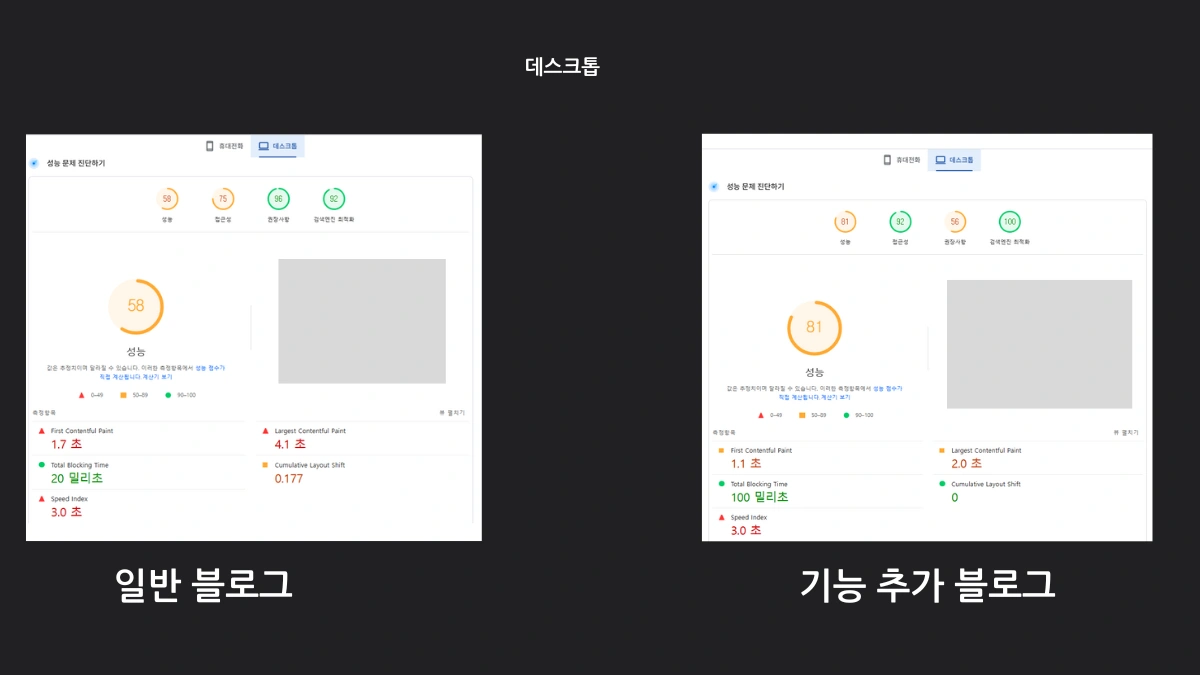
So, what performance differences are observed between a blog with all the advanced features introduced above and an ordinary blog with basic settings? We compared the feature configuration and optimization level of the two blogs through actual testing (based on Google Lighthouse).
Ordinary Blog: Minimum Settings Based
- Ad Configuration
- Only Google AdSense applied
- Exposure location: Sidebar, top/bottom, some positions within the body
- Ad count is upper-middle level, but optimized placement is lacking, leading to low revenue efficiency
- Skin Customization Level
- Some design elements modified
- Simple SNS share buttons added
- Structured data, automation features, etc., are not applied
Feature-Applied Blog: Full Feature Operation and Optimization
- Ad Configuration
- Google AdSense, Adfit, Dible, Tenping, affiliate ads, etc. various monetization models fully applied to the blog
- Automatic ad insertion by location (comments, headings (H2/H3), lists, TOC) and optimized placement based on AB testing
- Includes ad loading optimization and conditional output features (revenue maximization strategy)
- Feature Configuration
- All 14 core features applied (automatic rel attribute setting, TOC generation, YouTube Lazy-Load embed, TTS, structured data, video overlay, automatic ad insertion, etc.)
- Includes features personally developed by the operator (e.g., adjusting ad count based on article length, displaying events upon entering specific categories, etc.)
- Mobile/desktop responsive scripts fully equipped
- Full Skin Customization
- Overall modification of HTML/CSS structure and enhancement of semantic markup
- Insertion of asynchronous JavaScript scripts for dynamic content processing
- Page loading optimization and UX-centric structure reorganization
Google Lighthouse Based Performance and Optimization Comparison
| Item | Ordinary Blog | All-Features Added Blog |
|---|---|---|
| Ad Revenue Structure | Single (AdSense focused) | Complex monetization model operation (revenue maximization) |
| SEO Optimization | Basic level | Automatic Structured Markup Insertion (induces Rich Results) |
| User Experience | Basic SNS sharing | TTS, Automatic TOC, Automatic Thumbnail Processing, etc. (increases dwell time) |
| Content Visibility | Simple images/text | Automatic YouTube thumbnail conversion, video overlay, etc. (strengthens branding) |
| Item (Core Web Vitals) | Ordinary Blog | Feature-Added Blog | Comparison (Influence Factor) |
|---|---|---|---|
| Search Engine Optimization (SEO) | 92 | 100 | Influence of Structured Data and Semantic Link Settings |
| Accessibility | 92 | 75 | Interference from ad and script elements (room for improvement) |
| Best Practices Score | 81 | 75 | Influence of numerous external ads and scripts |
| LCP (Largest Contentful Paint) | 4.1 sec | 2.0 sec | Result of Image/Video Lazy Loading and Cache Optimization |
| CLS (Cumulative Layout Shift) | 0.177 | 0.000 | Perfect stability achieved through pre-reserving ad space |
| TBT (Total Blocking Time) | 20ms | 100ms | Influence of increased ad/script execution (critical impact avoided through asynchronous processing) |
| Overall Performance Score | 58 | 81 | Overall performance improvement due to Core Web Vitals (LCP/CLS) enhancement |
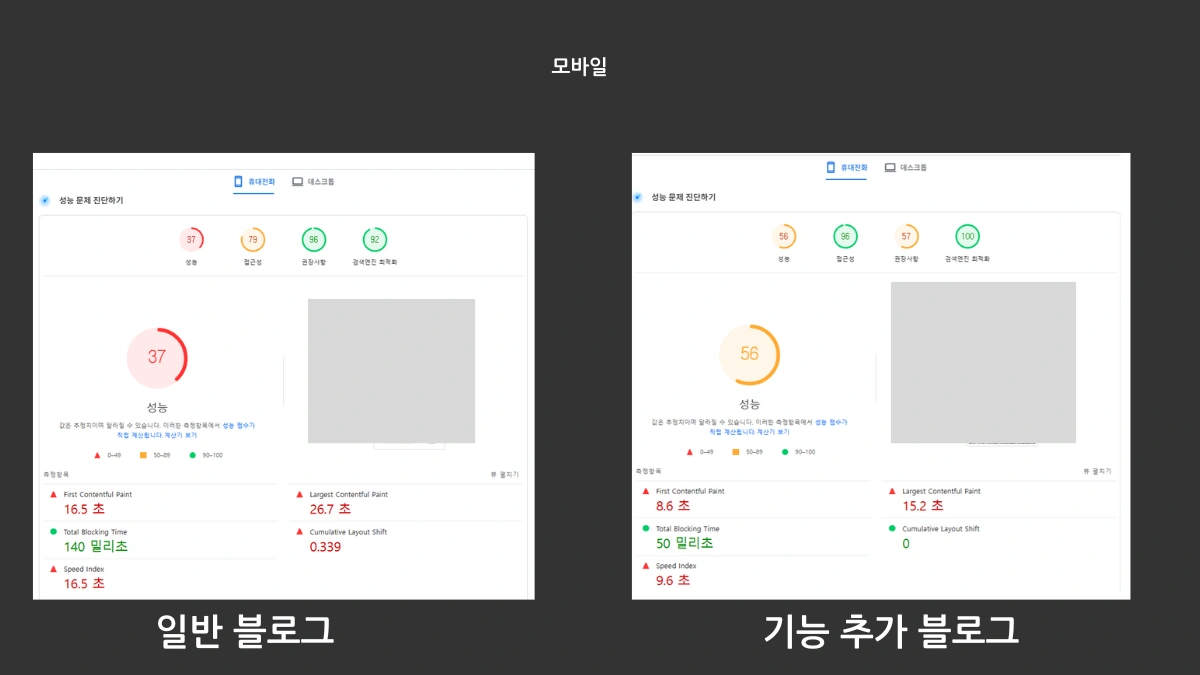
Data-Based Interpretation: Analysis of Feature Addition Effect
1. Search Engine Optimization (SEO) Score: 92 100 Points Achieved
The score reached 100 out of 100 through the reinforcement of core SEO elements such as automatic insertion of structured data (VideoObject, HowTo, ImageObject), rel attribute settings, and automatic TOC. This forms the basis for a significant increase in Rich Snippets display and exposure opportunities in search results.
2. Speed and Stability Innovation: Major LCP and CLS Improvement
- LCP (Largest Contentful Paint): Display time was dramatically reduced from 4.1 seconds to 2.0 seconds by utilizing Lazy Loading and caching for images and videos.
- CLS (Cumulative Layout Shift): Perfect stability secured (0.000) through the strategy of fixed ad placement and pre-reserving space. This meets Google's Core Web Vitals.
3. Explanation for TBT Increase and Accessibility Drop
The Total Blocking Time (TBT) increased due to the higher volume of script execution, but it was confirmed that no critical impact on page rendering occurred because most were handled via Asynchronous (Async) processing. The drop in the accessibility score is due to the visual/functional complexity of TTS, overlays, and numerous ads, with additional room for improvement by changing ad loading methods.
4. Overall Evaluation
| Item | Ordinary Blog | Feature-Added Blog | Evaluation |
|---|---|---|---|
| SEO | Upper-Middle | Superior | Significant effect of structured markup and link optimization |
| UX (Accessibility) | Good | Average | Script interference needs adjustment, dwell time increase is certain |
| Speed and Stability | Average | Excellent | User satisfaction significantly improved due to LCP/CLS enhancement |
| Ad Profitability | Average | High | Effect of utilizing multiple platforms and automatic placement optimization |
In summary, the Tistory blog is more than just a content posting platform; it can achieve website-level performance and monetization depending on the operator's technical setup. The blog's growth curve can change significantly based on how proactively features are applied.
When Utilized Properly, a Blog Becomes a 'Site': Final Conclusion
By going beyond a simple blog and equipping Tistory with advanced features, you can comprehensively improve search exposure, dwell time, ad revenue, and user satisfaction, not just increase visitor count.
The blog is now evolving beyond the preconception of merely being a space for posting articles, into a platform capable of implementing site-level functionality.
This is Tistory blog's unique strength, allowing it to be utilized as a true Site-Level Blog.